Garbage In, Spaghetti Out: Keeping AI Code Generation Grounded in Scrum
1. The Velocity Illusion: The Hockey Stick Trap
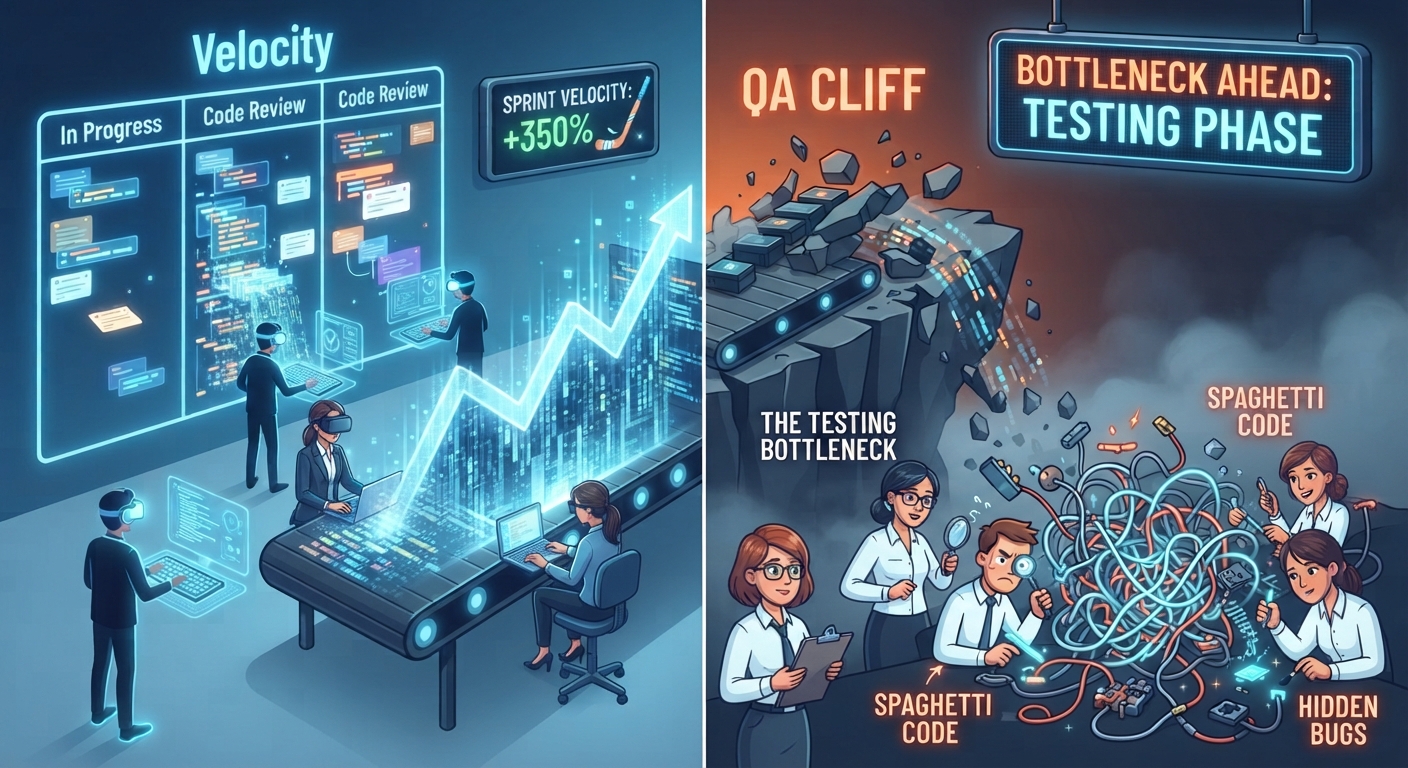
I really love the impact that AI code generation has had on my professional life as a developer and software engineering leader. Stories move from "In Progress" to "Code Review" at lightning speed. The Sprint velocity graphs look like hockey sticks (our Carolina Hurricanes won the Stanley Cup this year, so I had to mention hockey sticks somewhere!).
It is intoxicating to watch features materialize in minutes. But as any hockey fan knows, a breakaway speed doesn't win the game if you can't protect the goal. In our Scrum workflows, that initial burst of speed is proving to be a dangerous vanity metric.
2. The QA Cliff: Where Speed Meets Reality
However, QA becomes the bottleneck, especially if developers have not done a good job in unit testing or reviewing the code generated by AI.
When code generation gets cheap, human review gets expensive. Developers push massive PRs filled with pristine-looking syntax that passed initial linting, treating code review as a rubber stamp. But when it hits QA, the cracks show. Without rigorous human validation upstream, QA teams are left drowning in subtle state bugs, missing edge cases, and brittle logic that automated tools missed. We traded a coding bottleneck for a testing cliff.
3. Garbage In, Spaghetti Out: The Prompting Discipline
With my teams, we have found that AI does a really good job of creating great code when the prompts or rules are well constructed such that software design best practices are followed. If there are incomplete prompts or rules, then spaghetti code becomes an unfortunately reality.
AI doesn't inherently understand architecture; it predicts patterns based on context. If you feed it vague requirements or leave out your team's design standards, it won't push back; it will cheerfully generate thousands of lines of decoupled, non-compliant spaghetti code. The quality of the output is a direct reflection of the discipline of the prompt. Clean architecture requires clear, constraint-driven instructions upfront.
4. Restoring Balance to the Sprint
To keep our teams moving forward without burning out QA, we've had to adapt our Scrum habits:
Prompt Guardrails: Enforcing strict repository rules, custom instructions, and modular prompting so the AI adheres to design patterns by default.
Redefining Code Review: Shifting reviewers' mindsets from "checking syntax" to "stress-testing logic and edge cases."
Shift-Left Unit Testing: Requiring developers to explicitly verify and expand AI-generated unit tests before a ticket is even allowed to touch the "Code Review" column.
AI hasn't eliminated hard work in software engineering; it has just moved it from writing boilerplate to enforcing architectural integrity.